
There’s a Map for That: Using Mapping Techniques to Support Human-Centered Product Development

At Kaleidoscope, we often find that the biggest barriers to innovation aren’t a lack of ideas or supporting information, but a lack of shared understanding. Mapping helps us transform complex processes and research data into clear directions for design.

A cornerstone of human-centered design is deeply understanding the people you’re designing for and the context in which your solutions will live. Mapping is one of the foundational methods our design researchers use to analyze and visualize the systems, processes, and experiences that shape design outcomes.
 

BENEFITS OF MAPPING
For product development efforts of all sizes and budgets, dedicating time to mapping early in the process pays dividends throughout the project.

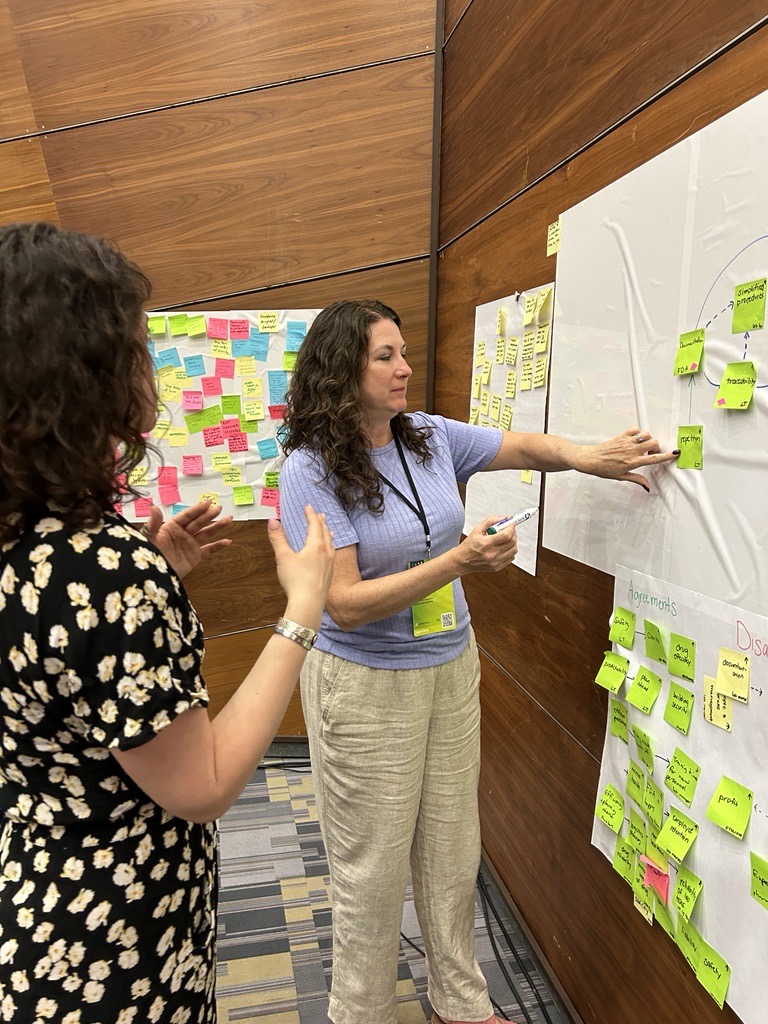
In the early stages – when a team is defining and framing the problem – visual maps serve as alignment tools, establishing a shared understanding of the current state. This is especially valuable for multidisciplinary teams, where each member brings unique expertise and often differing ideas about what users experience today and what an ideal future should look like.

Once research is conducted with users and other stakeholders, maps serve as a framework for visualizing research data and formulating actionable insights. They help teams convey large amounts of sometimes complex information both clearly and concisely.

Many teams believe they have a solid understanding of users’ needs and workflows. But when research findings are laid out visually, misconceptions, assumptions, and knowledge gaps often reveal themselves.

Finally, as a pivot point between research and ideation, mapping is a catalyst for uncovering opportunities and ultimately conceptualizing and visualizing new solutions and strategies.


MAPPING TECHNIQUES

At Kaleidoscope, we rely most often on three mapping techniques. Distinguishing between each isn’t critical; techniques can overlap or evolve depending on context. What matters is selecting the approach that best fits the project: the number of actors involved, the type of process, and how the map will ultimately be used.
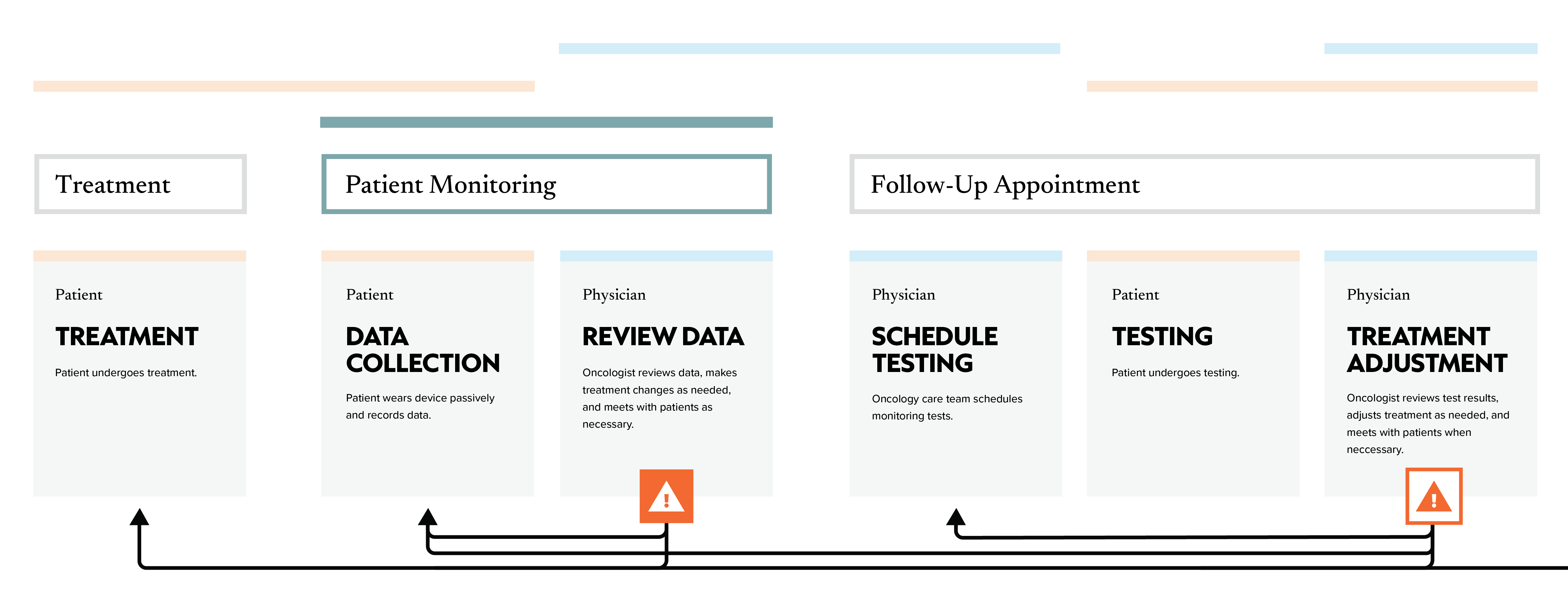
  • Process Mapping visualizes a workflow that typically involves several people or entities. It highlights interconnected systems and the handoffs between individuals or teams. Often, several smaller workflows are nested within a larger process. Examples include a company’s onboarding process, a hospital’s medication management process, or a clinical team’s workflow for triaging, treating, and discharging patients.
  • Procedure Mapping is a more focused form of process mapping used to illustrate the workflow for a single event. At Kaleidoscope, this often means a medical procedure (e.g., a surgery or the use of a medical device), but non-medical examples include the check-in procedure at a hotel or the exact sequence a barista follows to prepare a drink.
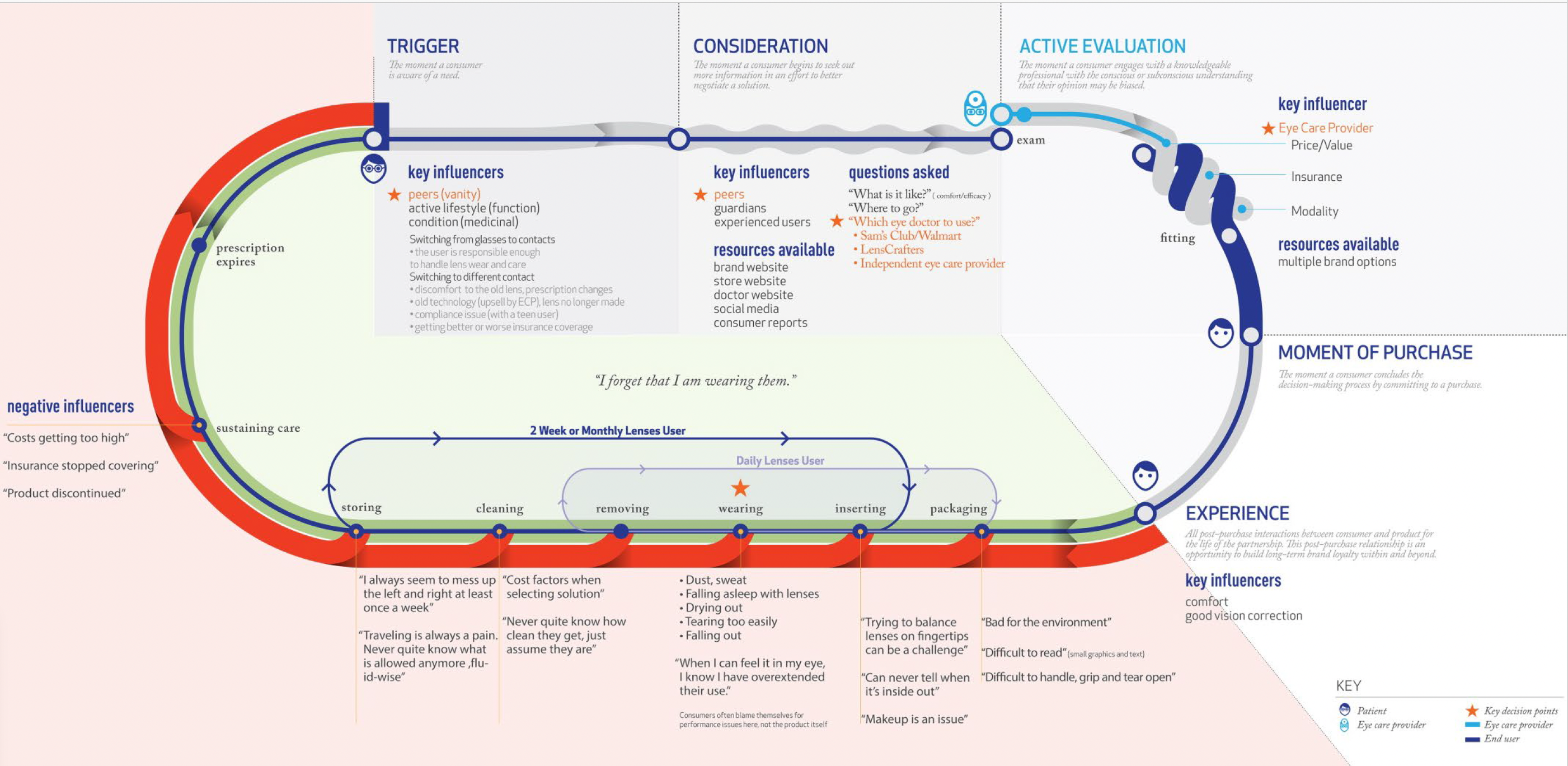
  • Journey or Experience Mapping captures a user’s experience from their perspective. This could be a single event (like a shopping trip) or a longer arc (such as a product experience from initial interest through adoption and ongoing use).


DESIGNING THE MAP TO FIT THE NEED

Regardless of the type, these maps all communicate what actually happens, as revealed through primary research—whether direct observation, in-depth interviews, or both. Even before formal data collection begins, defining the tasks or steps along the map’s x-axis provides a framework for systematic data gathering. Collaborating on this early version with the project team is valuable not only for orienting researchers to the problem space but also for surfacing assumptions and gaps in knowledge.

Once a draft sequence is defined, the map’s y-axis structure is shaped by its intended purpose. If the goal is to understand how various actors work together to achieve a common outcome, representing each individual’s actions in parallel makes sense. If the objective is to compare multiple users or events to identify differences in behavior or duration, separating by instance or user is more appropriate.

There are numerous possibilities – and often, layering multiple perspectives reveals deeper meaning and greater insight.
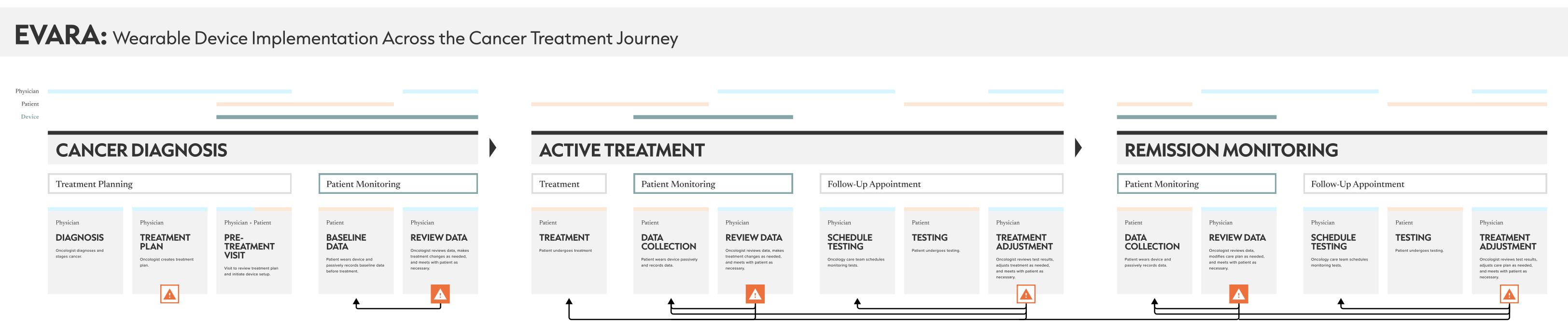
process mapping in product development

THE IMPACT OF MAPPING

When thoughtfully constructed, maps become enduring tools, not only for communicating research findings but for supporting UX and product development teams throughout the design cycle. Our team has used maps in the following ways, just to name a few:

  • Procedure maps focused on surgical instrument usage sequencing and duration helped inform user needs, product requirements, training materials, and instructions for use (IFUs)
  • Process maps highlighting gaps and pain points in the process of teaching optometry patients to use contact lenses informed prioritization of R&D and marketing workstreams across service, physical, and digital solutions
  • Journey maps of competitive shopping experiences helped our client define opportunities for differentiation and competitive advantage

Ultimately, mapping strengthens alignment, sharpens insight, and creates a foundation for more informed and intentional design.

Let's map out your next project, together.

Back to Insights + News

Author

  • Charlotte Lux

    Design Research Manager | [email protected]

    Charlotte is a design research manager at Kaleidoscope, with 20+ years of experience in user-centered design and research. She leverages multi-dimensional, immersive research to uncover unmet user needs and to inform the development of solutions for clients ranging from medical and pharmaceutical companies to consumer product manufacturers and global technology companies. 

5 Psychology Principles That Strengthen Design Research

Design research derives its identity from several larger disciplines, including anthropology, human factors, and sociology. Perhaps lesser-known, and surprising to me, was how embedded psychology is in this discipline. Shortly after I changed careers from clinical psychology to research, a colleague asked me to collaborate on a research activity designed for teens and adults. The exercise invited participants to choose cards labeled with emotions to describe their experience with an at-home medical procedure. Drawing on my background as a psychologist, I realized the emotions initially selected—like frustration or insecurity—were too complex for that age group. I recommended using simpler, primary emotions such as fear, happiness, and anger instead. This collaboration gave me confidence my psychology background could enrich design research in ways I had not imagined.  

Psychology adds another layer to our multidisciplinary approach, enriching and deepening our user-centered research. Below are five key principles we regularly use to enrich our research.  

1. Listen More, Learn More. In psychology, Carl Rogers’ Person-Centered Therapy emphasizes that people are the experts in their own lives. The therapist’s role is not to steer the conversation, but to listen and create space for the client to share openly.

Design research works the same way. When I interview a user, my job is not to tell them what I think matters. The best insights come when users guide the conversation. This approach can uncover needs that users may not think to share until given the space to do so. 

2. Empathy Builds Insight. Empathy is a cornerstone of both psychology and design research. In psychology, empathy allows therapists to understand a client’s perspective without judgment, building trust and deeper insight. In design research, empathy serves a similar role—helping us see products and experiences through the user’s eyes. By setting aside assumptions and genuinely connecting with users, we uncover not just what they do, but how they feel, which leads to more human-centered and meaningful designs.

3. From Insight to Impact. In both psychology and design research, the real value lies not just in understanding people, but in using that understanding to create meaningful change. Psychologists study behaviors and goals to design interventions that improve well-being. Similarly, design researchers uncover what users are trying to achieve, along with the barriers they face, and then translate those insights into design decisions. This process ensures that our research doesn’t stop at knowledge—it shapes products and experiences that truly support people in reaching their goals.

4. What People Do vs. What They Say. Psychology is the study of human behavior and mental processes. In practice, that often means observing how people behave in real settings rather than relying only on what they say. Someone may claim they get plenty of exercise, but observed behavior might show long periods of sitting broken up by short periods of movement. Observation reveals the gap between perception and reality.

Design research depends on observation. Watching how people interact with a device, tool, or environment often uncovers workarounds or struggles they may never mention in an interview. These small details—hesitations, repeated errors, improvised fixes—are often the very clues that point us toward better design solutions.

5. Making the Invisible Visible. Psychologists study concepts like hope, motivation, or attitudes that cannot be observed directly. To understand them, we design questions and experiments that reveal underlying patterns.

Design researchers face a similar challenge when studying products that do not yet exist. How do you understand a user’s reaction to a future product? You construct thoughtful questions, scenarios, and prototypes that invite users to imagine and respond. By treating these unseen elements seriously, we can design not just for what people do now, but for what they might need tomorrow.

Equally important, we dig below the surface of what people say or do to uncover the why—the possible sources of problems and motivations driving behavior. Often the frustrations or workarounds we observe are symptoms of deeper issues. By identifying those underlying drivers, we create solutions that address not only the immediate challenge but also the broader needs shaping user behavior.

WHY IT MATTERS

Blending psychology and design research creates a powerful lens for innovation. It helps us: 

  • Put users at the center of product development.
  • Discover needs and challenges that are not immediately obvious.
  • Design products that do not just function but resonate with real human experiences. 

At Kaleidoscope, this cross-disciplinary thinking is part of how we approach research and design. Research thrives when we bring multiple disciplines together – psychology included. When we approach design research with a multidisciplinary lens, we create solutions that are more intuitive, empathetic, and impactful. 

If you are a designer, researcher, or product developer curious about how psychology can strengthen design, let’s connect. The more we share perspectives across disciplines, the better we can design products that truly serve the people who use them. Let’s start something, together.

Back to Insights + News

Author

  • Rachael Clark

    Senior Design Researcher | [email protected]

    Rachael brings over 10 years of research experience to her role at Kaleidoscope Innovation. She has advanced training in clinical psychology and mixed methods research methodology. Guided by the principles of positive psychology, Rachael uses a human-centered lens for deeply understanding the user experience. Her work at Kaleidoscope focuses on human-machine interaction and identifying design changes capable of positively impacting well-being at the individual and institutional levels.